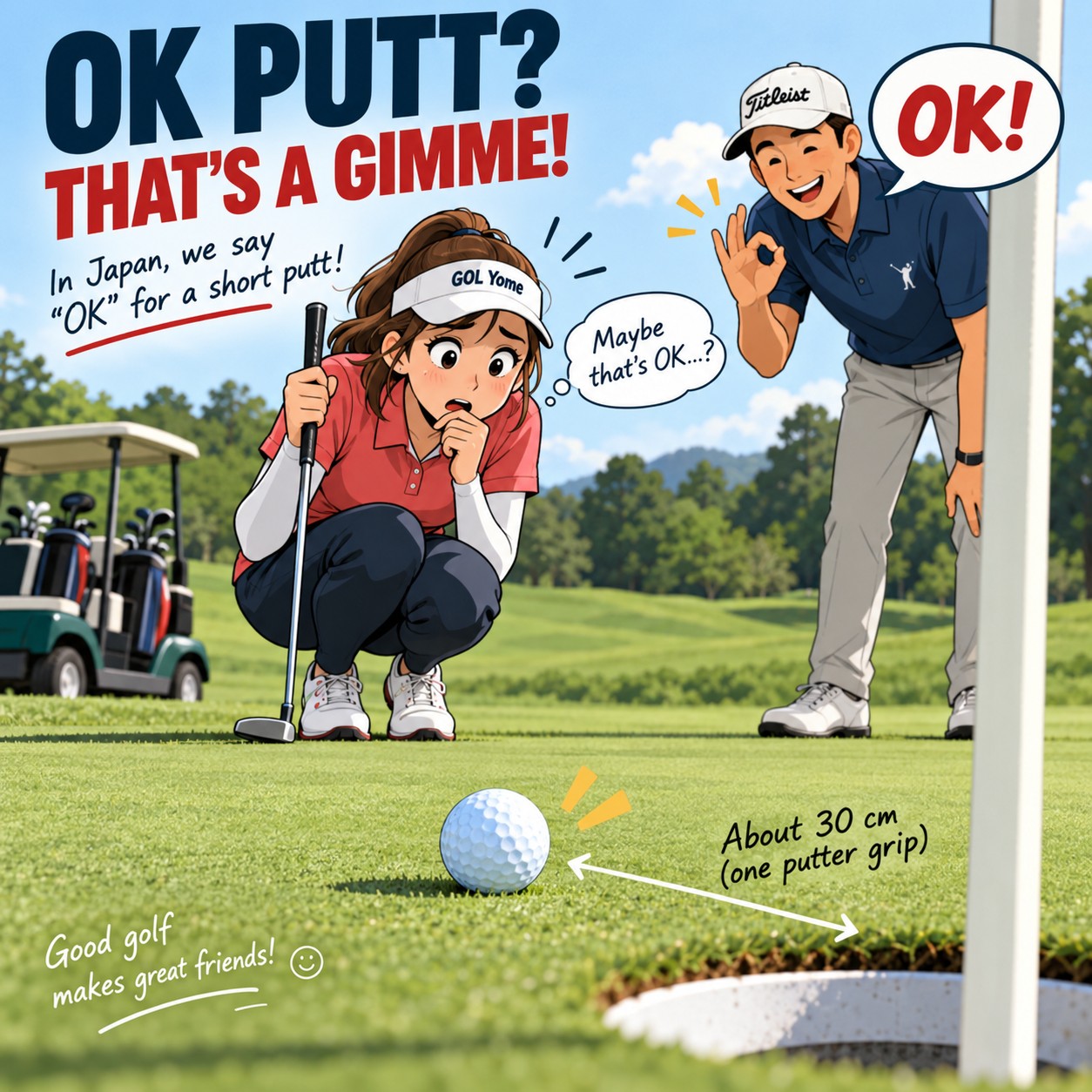
If you have played golf in Japan, you may have heard someone say:
In Japan, what English-speaking golfers usually call a “gimme” is commonly called an “OK putt.”

GOL Yome Loves an “OK”
We have mentioned this many times on our Japanese blog, but putting is definitely not GOL Yome’s favorite part of golf.
Actually, if she could avoid even one putt during a round, she probably would!
Whenever her ball gets close to the cup, she sometimes looks at the other players with a hopeful expression:
And, to be fair, she usually gets it.(笑)
But before one recent round, she was given some bad news:
Every ball had to go into the hole.
So what happened?
Did GOL Yome set a new personal record for the most putts in a round?
How Close Does a Putt Need to Be for an “OK”?
But practically, distance would change occasionally.
In casual rounds, golfers use their own judgment.
If you’re a good putter, your friends might give you a slightly longer one.
If you’re a beginner who occasionally misses even a 30 cm putt…
Well, your friends might gradually become a little less generous!
GOL Yome knows something about that.
Why Do Golfers Give “OK” Putts?
One reason is simply to keep the game moving.
This can be particularly useful when the course is busy or when playing with beginners.
Sometimes, if a beginner has already taken three or more putts and the group is falling behind, another player may say “OK!” even when the ball isn’t particularly close to the hole.
If that happens, don’t be disappointed.
Your playing partners may simply be trying to maintain the pace of play.
What Should You Do When Someone Says “OK”?
If another golfer gives you an “OK,” you can simply pick up your ball and count the conceded putt as your next stroke.
For example, if your third shot finishes close to the hole and someone says “OK,” you pick up the ball and record a 4.
If someone gives you a rather generous “OK,” particularly when the course is busy, it may be a sign that the group needs to speed things up.
Pick up your ball and move on.
Of course, if nobody is waiting behind you and you’d really like to hear that satisfying sound of the ball dropping into the cup, you can ask your playing partners if you can putt it out for practice.
“OK” vs. “Gimme”
This is the useful bit of Japanese golf vocabulary to remember.
So when a Japanese golfer points at your ball beside the hole and says:
