
In August 2026, I played at Nanso Country Club in Ichihara, Chiba.
The club has two 18-hole courses, East and West, for a total of 36 holes. This time, we played the West Course.
The three golfers in my group were all better players than me, so I spent most of the round concentrating on my own game. Unfortunately, I had almost no mental space left for taking photos.
The one photo I did take was of a bunker badly damaged by heavy rain before our round.
So this article is a little different from my usual course reviews. With fewer photos, I will focus on what it actually felt like to play the West Course.
- Quick Information for Foreign Golfers
- About 60 Minutes from Yokohama by Car
- 36 Holes: East and West
- A Huge One-Green Layout
- Slow Summer Greens
- Heavy Rain Damage in the Bunkers
- Practice Facilities
- Lunch Was Good and the Portion Was Just Right
- A Fast and Comfortable Pace of Play
- Why I Took So Few Photos This Time
- Final Thoughts on Nanso Country Club West Course
Quick Information for Foreign Golfers
| Location | Ichihara, Chiba Prefecture |
|---|---|
| Courses | 36 holes: East Course and West Course. We played the West Course. |
| Booking | A friend who is a club member booked the round for us. |
| Green Fee | About ¥22,000, including lunch, on a weekend (approximately US$138 at ¥160/US$1) |
| Start Time | 7:07 a.m. |
| Style of Play | Self-play |
| Golf Cart | Self-driving cart with remote control. Fairway entry was not allowed. |
| Practice Facilities | Downhill driving range of more than 200 yards, plus an approach practice area |
| Dress Code | It did not feel particularly strict during our visit, although standard Japanese golf-club attire is recommended. |
| Rental Clubs / Shoes | Not checked on this visit. |
About 60 Minutes from Yokohama by Car
It took about 60 minutes from my home in Yokohama by car.
We used the Tokyo Bay Aqua-Line, and after leaving the expressway, the drive on local roads was very smooth.
There was almost no traffic on the way to the course, which made the morning drive surprisingly easy.
For golfers living around Yokohama or the southern Tokyo area, Chiba golf can sometimes feel far away because of traffic, but the morning access to Nanso Country Club was very comfortable on this trip.
36 Holes: East and West
Nanso Country Club has two courses: the East Course and the West Course.
Both have good length, so this is not the kind of course where you can rely only on short irons and wedge play.
According to my friend who is a member, the West Course can be booked by general visitors, while playing the East Course normally requires being accompanied by a member.
The West Course feels spacious and comfortable from the tee, but there is still plenty of distance.
You need solid shots throughout the round.
A Huge One-Green Layout
One of the biggest features of the course was the size of the greens.
The course now uses one green per hole. According to my member friend, the greens were originally designed as a two-green system and were later combined into one large green.
That makes approach shots more important than they first appear.
Simply hitting the green does not necessarily mean you are in a good position.
If your ball finishes on the opposite side of the green from the hole, you can easily be left with a very long first putt.
And from there, a three-putt becomes a very real possibility.
Slow Summer Greens
The greens were also noticeably slow during our round.
We repeatedly left putts short. It was not just me — several players in our group did the same thing.
My member friend explained that during the Japanese summer, the grass is sometimes kept slightly longer to protect it from heat damage.
As a result, the greens can become slower than usual.
The combination of very large greens and slower putting speed made them more difficult than they looked.
Heavy Rain Damage in the Bunkers
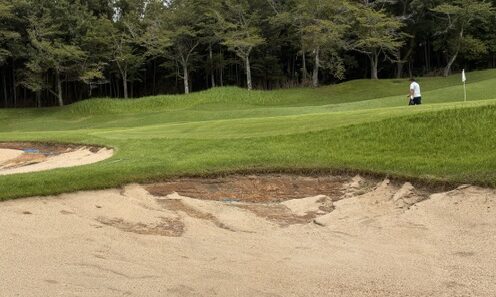
One of the most memorable sights during the round was the condition of some of the bunkers.
Chiba had experienced very heavy rain before our visit, and the effects were still clearly visible on the course.
In some bunkers, a large amount of sand had been washed away, exposing the soil underneath.
The photo above was taken during our round.
My member friend told me that repairing this type of bunker damage can be very expensive.
Looking at the condition of the bunker, it was easy to understand why. This was clearly more than simply raking the sand back into place.
Seeing storm damage on the news is one thing, but seeing the effects directly on a golf course gave me a new appreciation for how much work goes into maintaining a course after extreme weather.
Practice Facilities
I used the driving range before our round.
It is a downhill range with more than 200 yards of visible distance, so there was enough room to hit a driver properly before teeing off.
There is also an approach practice area.
For golfers who like to warm up properly before a round, the practice facilities are more than adequate.
Lunch Was Good and the Portion Was Just Right
I enjoyed the lunch as well.
Golf-course lunches in Japan can sometimes be quite large, but the portion here was just right for me.
It was enough to feel satisfied without eating so much that the second nine became uncomfortable.
A Fast and Comfortable Pace of Play
We started at 7:07 a.m.
What surprised me most was how smoothly the round moved.
We hardly had to wait at all.
There also seemed to be many experienced golfers on the course, and groups were moving at a good pace.
We finished at around 12:30 p.m.
Because this was August in Japan, I had expected the heat to be severe. But with such an early start, we were already finished before the hottest part of the afternoon.
That made the summer round much more comfortable than I had expected.
Why I Took So Few Photos This Time
There are far fewer photos in this article than in my usual golf-course reviews.
The reason is simple.
The three golfers I played with were all one level above me.
They played quickly and consistently, and I found myself concentrating hard just to keep my own game moving at the same pace.
Normally I would take photos of the tee boxes, clubhouse, lunch and other parts of the course.
This time, I simply did not have the mental space.
On the other hand, it forced me to concentrate on golf for the full 18 holes.
With almost no waiting and a finish around 12:30 p.m., it was a very enjoyable rhythm of play.
Final Thoughts on Nanso Country Club West Course
If I had to describe the West Course in one sentence, it would be:
“A spacious but long course where the huge greens make you think all the way through the hole.”
There is room to swing freely, but the course still has plenty of distance.
The large greens also mean that simply reaching the putting surface is not enough. Where you leave the ball matters.
On this visit, the slow summer greens and the bunker damage from heavy rain created conditions that were probably a little different from normal.
But the overall impression was very positive.
Most of all, the pace of play was excellent. We moved smoothly through all 18 holes with almost no waiting.
Next time, I hope I have enough余裕 to take a few more photos.
And if I get the opportunity, I would also like to play the East Course with a member.

コメント